

Word of advice:
Don’t ask a question to an underwater welder without doing your homework.
You’ll get slammed. Big time.
They’re not subtle about it.
I’ve talked with a lot of underwater welders on the phone and on the internet. You guys have the most incredible stories on earth - I’m a firm believer in that. That’s why we tell them.
But some of them are in dire need of some salsa to go with the chip on their shoulder.
As you may imagine, your pessimism has a way of spreading, quite efficiently actually, through online forums and social media groups.
This pessimism does a few things for the diving industry as a whole:
- Represents welder-divers as a group of cynical, discontent workers.
- Decreases enthusiasm for up-and-coming divers.
My strong desire to question their negativity is suppressed by fear of potential hostility. Hostility is bad for business, so I try not to go that route.
But I can’t take it any longer.
Underwater welders: What starts your spiral of cynicism? How do you pull out of it?
Here’s a few theories I’ve gathered from my experiences and those of my diver colleagues:
Top 3 Welder-diver Negative Ideas & Solutions
1. Reality Check: It’s not all Underwater Welding
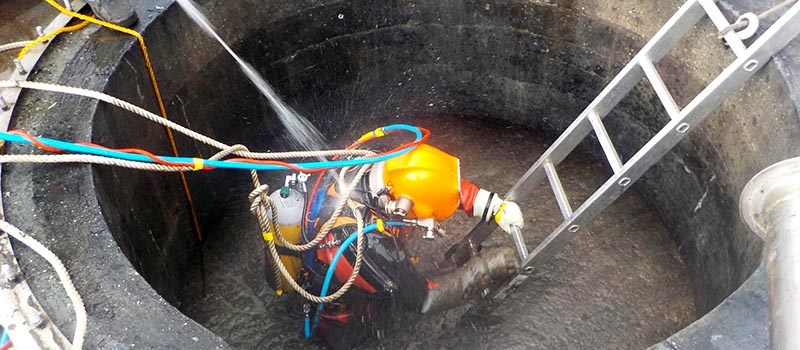
Few divers - if any - apply to underwater welding school with dreams of swimming in poo. Most dream of swimming in cash, along with deep-sea adventures or joining and slicing metal. But somewhere along the line, they’re hit with a hard reality.
Commercial diving is a job. And it’s more than welding underwater.
More and more, employers value employees who learn new skills and round out their abilities. This is directly opposite to many people’s line of thinking, who believe that they’ll specialize in one maritime area and do it every day, all day.
It’s not all adventure, either.
Emotional Roller coaster
I often see welder-divers whose emotional swings could create a whole theme park. The kind that makes you vomit on the roller coaster. If you’re super optimistic one day about underwater welding, then pissed at the lack of safety standards the next day, you need to take things at a more methodical pace.
Don’t let the hard realities hit your emotions like a boat anchor; Let it sink in slowly.
Then, and only then, communicate your frustrations to divers that you know personally. Try and get a balanced perspective.
Remember that negativity spreads quickly, so evaluate your reasons for your attitude.
The diving industry what you make it - like any other career. Keep this in mind before you enter training and invest.
2. Self-employment is a Tough Gig…in any Industry

Once underwater welders jump into training and certification with both feet, they’re committed. At least at first.
A dive school may land that first job for them right out of training (job placement is a huge selling point for a diving institute; I highly recommend finding one with this characteristic).
Where the Buck Begins & Stops
But after that first job, responsibility of employment rests squarely on your shoulders as a welder-diver.
It’s really difficult at first. There’s no way to sugarcoat it.
With little experience, you’ll need to make your own luck to gain employment.
It’s at this point that your mindset may turn to one, flawed idea:
You believe that you’re stuck in the only industry with employment difficulties.
Not true. By a long shot.
Self-employment is difficult in all categories of business - including my own industry.
It goes without saying that if you really crave life as a diver, you’ll have to beat out the competition. Perhaps even those who have more experience than you.
Easier said than done.
But it is possible; people do it all the time. If you don’t have a self-starter attitude, perhaps you need to look real hard at #3 on our list:
3. Maybe Commercial Diving isn’t Your Calling

It’s not in my best interests to include this reason, as I’m all about divers who persist.
But it’s not for everyone.
If underwater welding is your Plan Z for careers, you might want to rethink your decision. The investment of training costs a good chunk of change, albeit much less than the average Bachelor’s degree.
Plus:
If you have zero experience in surface or underwater construction, your road to diving success just got a lot muddier.
Even if you have the greatest work ethic on the face of the earth, your optimism will plummet in a job you don’t have passion for. Make sure this is something you really want and are content with investing into (at least for 3 - 5 years).
Otherwise, find a different course. If you still love the maritime industry - just not diving - there’s plenty of other jobs you may enjoy.
What do you think? Is the diving industry pessimistic?
Tell me in the comments!